Best Hospital Management System in India (2026): Selection & Compliance Guide
A comprehensive B2B buyer’s guide comparing India's top hospital information systems (HIS/HMIS) on ABDM certification, NHCX billing readiness, NABH compliance, and legacy data migration.
Cliniqwise HMS (by Tridev Technologies)
A cloud-based Hospital Management Software optimized for Indian clinics and mid-sized hospitals (10–200 beds). Pre-certified for ABDM Milestones 1-3, NHCX digital claims, and DPDP patient privacy rules.
Why We Wrote This Guide: Meeting New Indian Health Rules
A Hospital Management System (HMS), or Hospital Management Information System (HMIS), is an enterprise software suite designed to automate clinical, financial, administrative, and inventory operations in healthcare facilities. To comply with new directives from the National Health Authority (NHA) under the Ayushman Bharat Digital Mission (ABDM) and the Ministry of Electronics & IT's DPDP Act 2023, modern Indian healthcare facilities must migrate from legacy on-premises databases to secure cloud EMR systems supporting ABHA digital health IDs, direct National Health Claims Exchange (NHCX) insurance processing, and audited patient consent logging.
This guide is built to help hospital directors, doctor-founders, and clinic managers pick the right software without getting lost in technical jargon or high-pressure sales pitches. We have checked India's top 10 options on actual speed, ease of billing, and setup support.
🛡 Full Disclosure: Our Relationship with Cliniqwise
Disclosure: Tridev Technologies is the core engineering and integration partner for Cliniqwise HMS. In this guide, we evaluate Cliniqwise objectively alongside other Indian market leaders based on standard technical benchmarks like ABDM compliance levels, NHCX API sandboxing, deployment speed, and data privacy protocols.
Workflow-Focused Software for Clinics & Mid-Sized Facilities (10-200 Beds)
Why it stands out: Cliniqwise is a cloud-based software that manages outpatient visits (OPD), inpatient wards (IPD), pathology labs, and pharmacy sales. Pre-configured for Ayushman Bharat (ABDM) rules with safe data migration and setup handled by the Tridev Technologies engineering team.
3 Days
Setup Time
99.9%
Uptime Vetted
0%
Billing Leakage
Recommended Shortlist by Hospital Size
To simplify your B2B evaluation process, here is our systems engineering team's recommendation mapped directly to facility size, clinical complexity, and support operational needs:
Clinics & Outpatient OPD
Best for single-doctor or multi-specialty OPD consulting desks with up to 15 daily doctors. Focuses on fast digital prescriptions, queue tokens, and GST billing.
📢 Verdict: Best for rapid prescription delivery (under 30s) and WhatsApp patient billing.
Recommended Platforms:
Cliniqwise / HealthPlix
Nursing Homes & Mid-Scale HIS
Requires real-time IPD ward management, LIMS integration, active nursing checklists, centralized pharmacy stock management, and automatic ABDM Milestones 1-3 registry.
📢 Verdict: Best overall for integrating ward sheets with pharmacy stock and instant ABDM compliance.
Recommended Platform:
Cliniqwise Cloud HMS
Corporate Chains & Teaching HIS
Requires deep on-premises configurations, dedicated custom HL7 middleware, local backup redundancy, complex regional municipality tariffs, and internal IT server support.
📢 Verdict: Best for deep on-prem databases and legacy billing integrations.
Recommended Platforms:
Insta HMS / Backbone HIMS
How We Evaluated the Software
We looked at the leading hospital software options in India using three main criteria:
Hospital Operations
Whether the system covers OPD registration, IPD ward sheets, OT, ICU management, laboratory reports, and pharmacy stock tracking in one place.
ABDM & Privacy Compliance
Certified link to ABHA health cards, direct cashless insurance claims (NHCX), database encryption, and safe logs to meet the DPDP Act rules.
Features Built for India
Support for GST billing splits, regional languages, instant updates sent directly to patients via WhatsApp, and automatic doctor commission billing.
How We Kept Our Reviews Fair & Honest
Unlike directory sites that rank software based on who pays the highest commission, our reviews are based on actual sandbox testing and feedback from doctors, receptionists, and billing teams in Indian hospitals.
✓ Sandbox Testing
We spent hours testing each system's test version, creating fake patient records, writing dummy prescriptions, and billing test items.
✓ Real Feedback
We called software support desks ourselves to check their response time, and interviewed administrative staff at hospitals in Tier-1 and Tier-2 Indian cities.
Scoring Benchmarks
Vetted & Reviewed By Systems Experts
To ensure clinical accuracy and technical validity, this guide has been reviewed by senior health informatics leaders:
Prince Meghani
Healthcare SaaS Consultant
Prince is a Healthcare SaaS Consultant with 8+ years of experience deploying EMR systems, managing ABDM Sandbox integrations, and optimizing hospital revenue cycles across India.
Dr. Neeraj Gupta
Medical Informatics Expert (Datia Hospital)
Dr. Gupta is a clinical expert, medical informatics consultant at Datia Hospital, and former advisor to NHA sandbox working groups. He specializes in HL7 FHIR messaging standards, clinical EMR workflows, and ABDM compliance audits.
🗂 Our Review Policy
We do not accept paid promotions or sponsorships to list software here. Every review is based on hands-on testing—we check how easy it is to register patients, how fast the pages load, and how simple it is to generate a bill. We disclose our relationship with Cliniqwise openly so you have the full picture before making a decision.
Top 10 HMS B2B Vendor Scannable Matrix (2026)
Quick reference comparing the top 10 hospital management platforms on core regulatory compliance, target segments, and technology standards:
| Software | Target Segment | Deployment | ABDM / NHCX Compliance | Est. Starting Cost (INR) | AI Voice Scribe | GST Billing Module |
|---|---|---|---|---|---|---|
CliniqwiseChoice | Clinics & Mid-Sized (20-200 beds) | SaaS Cloud | Milestone 1, 2, 3 + NHCX | From ₹2,000 / month | Integrated Voice-Rx | Auto Split & TPA Pre-Auth |
| Insta HMS | Large Tertiary Chains | Hybrid Cloud | Certified Integration | Custom Enterprise Quote | None | Full TPA Claims |
| MocDoc | Lab & Outpatient Clinics | Pure Cloud | ABHA & EMR Sync | From ₹6,000 / month | Templates Only | Manual Claims |
| Healthray | Mid-Sized Hospitals | Cloud/Desktop | ABDM Ready | From ₹3,000 / month | Basic Assistant | Pre-Auth Rules |
| Aarogya | Traditional On-Premise | On-Premises | Basic ABDM | Custom Local Server Pricing | None | Complex Local Tax |
| BackBone | Large Academic Chains | On-Prem/Private | Deep Integration | Custom Enterprise Quote | None | Full TPA Sync |
| Swanity | ERP-Scale Hospitals | Cloud/Private | ABDM Ready | Custom Quote | Resource Allocation | Inventory Billing |
| MedQR | Outpatient Queue | Cloud SaaS | ABHA Lookup | From ₹2,000 / month | Voice Assist | Not Supported |
| HealthPlix | OPD & Rx Only | Cloud/Mobile | ABHA Generation | Freemium (OPD Rx Only) | Rx Predictions | Not Supported |
| Ezovion | Multi-Specialty Clinics | Cloud-Based | ABDM Compliant | From ₹4,500 / month | Alerts Only | Manual Claims |
Comparative Feature Checklist: Cliniqwise vs. Typical HMS
To help technical buyers evaluate system capabilities, here is a detailed 15+ feature comparison between modern cloud-native architecture (Cliniqwise) and legacy hospital systems:
| Module / Feature Area | Cliniqwise HMS (Cloud-Native) | Typical Legacy HMS (On-Prem / Hybrid) |
|---|---|---|
| Outpatient Department (OPD) | ✓ QR-based ABHA Scan & Share check-in, real-time waitlist dashboards, and instant prescription generation in <30 seconds. | ✗ Manual registration entries by desk staff; local queue tickets printed on thermal paper; no health ID integration. |
| Inpatient Department (IPD) | ✓ Interactive bed allocation maps, digital discharge summaries automatically translated to FHIR formats. | ✗ Static text-based bed lists; manual discharge summaries typed in Word documents. |
| Nursing Station Control | ✓ Real-time nurse dashboard with drug administration charts (MAR) and automated vitals upload alerts. | ✗ Paper-based ward folders for nurse notes; manual data entry into database during shifts. |
| Pharmacy Inventory | ✓ Expiry date tracking (First-Expiry-First-Out) with automated low-stock alerts. | ✗ Manual stock bookkeeping; inventory counts done on monthly schedule; high risk of expired product leakage. |
| Laboratory (LIMS) | ✓ Direct connection with pathology machines; automated digital report signature and release. | ✗ Pathology results manually typed into templates from physical analyzer printouts. |
| X-Ray & Scans (PACS) | ✓ Integrated web-viewer to view X-rays and radiology reports directly inside the patient file. | ✗ Standalone desktop workstation viewer; film printing required for patient record files. |
| GST e-Invoicing | ✓ Automated billing splits for taxable (medicines) vs. non-taxable services, auto-generated HSN codes. | ✗ Manual tax calculations by accountant; separate billing sheets needed for pharmacy and clinical bills. |
| WhatsApp Automation | ✓ Instant WhatsApp messaging for receipts, prescriptions, and digital lab reports directly to patients. | ✗ SMS text alerts only (or paper-based printing); no media or report sharing via chat apps. |
| TPA & Insurance Claims | ✓ Direct connection with the NHCX government gateway to approve claims in hours instead of days. | ✗ Manual claims portal uploads of scanned PDFs; approval times range from 5 to 15 days. |
| Voice Prescription Typing | ✓ Built-in voice assistant transcribes doctor's spoken notes into digital prescriptions. | ✗ Not supported; requires typing all patient history manually on keyboards. |
| Regional Language Support | ✓ Patient-facing receipts, summaries, and WhatsApp messages generated in 6+ Indian regional languages. | ✗ English language documents only; staff translates documents manually for patients. |
| Works Offline | ✓ Continues working for patient registrations and payments even if the main internet goes down. | ✗ System halts entirely during local network or main internet connection downtime. |
| Patient Data Privacy | ✓ Tracks patient permission and record access history under DPDP Act rules. | ✗ Basic user access controls; no patient consent validation or file export tracking. |
| Software Integrations | ✓ Easy connection to external software, payment links, and medical devices. | ✗ Proprietary database structures; custom APIs require expensive developer consulting. |
| Database Backups & Security | ✓ Automated hourly backups stored on secure servers in India with a 99.9% uptime SLA. | ✗ Manual daily backups stored on local hard drives; high server maintenance overhead. |
Profiles of the Top 10 Hospital Software Systems
Here is our review of the top 10 hospital management systems (HMS) in India, written in plain terms to help you find the right fit for your facility:
1. Cliniqwise HMS: Best for Mid-Sized Indian Hospitals
In-House SolutionBest for Cloud Setup & Instant ABDM Compliance
Cliniqwise is a cloud-native hospital information system designed specifically for clinics, nursing homes, and mid-sized hospitals. It integrates OPD consultation queues, ward sheets (IPD), pathology laboratory devices, and multi-specialty GST billing into a single database. Built to operate on standard broadband connections, it eliminates the need for expensive local server infrastructure.
Pros / Key Strengths:
- Pre-certified for ABDM Milestones 1-3 (ABHA, FHIR, UHI)
- Direct integration with NHCX gateway for cashless TPA claims
- End-to-end data encryption mapped to DPDP Act residency standards
Limitations:
- Not suited for large academic medical centers (500+ beds) requiring dedicated on-premise mainframe middleware
- Lacks built-in PACS imaging hosting (requires third-party DICOM servers)
2. Practo's Insta HMS: Best for Large Hospital Chains
Best for Multi-chain Corporate Hospitals
Insta HMS is a well-established hospital system owned by Practo. It is built for large, multi-branch hospital chains that need to connect all their buildings, main pharmacies, and accounts in one system. While it is highly customizable and reliable for large chains, it is expensive to set up and takes a long time to get running.
- ABDM Sync: Certified links for government health IDs.
- Setup Type: Private cloud or local backup servers.
- Verdict: Best for massive hospital networks that have their own in-house IT team to manage the system.
3. MocDoc HMS: Best for Labs and Clinic Outpatient Work
Best for Diagnostic Labs and Consultation Clinics
MocDoc is a popular cloud system that is excellent for clinics that also run their own diagnostic lab. It connects directly to lab testing machines so reports are generated automatically. While it is fast for OPD billing and laboratory work, it lacks the advanced voice tools and ward features needed by larger, multi-specialty hospitals.
- ABDM Sync: Basic link to register patient ABHA numbers.
- Core Strength: Connects directly with laboratory machinery.
- Verdict: Great choice for clinics that get a major part of their business from laboratory tests.
4. Healthray: Best for Budget Compliance
Best for Hospitals Seeking Standard, Basic Features
Healthray is a simple, standard software designed for Indian clinics and hospitals. It helps you file Ayushman Bharat (ABDM) claims and manage daily operations. The screens look a bit older, but it gets the job done for hospitals looking for a basic, budget-friendly compliance system.
- ABDM Sync: Approved for government sandboxes.
- User Interface: Traditional layout that works on desktop computers.
- Verdict: A solid option if you need standard compliance reporting at a lower price point.
5. Aarogya HMS: Best for Local Server Setups
Best for Traditional On-Premise Installations
Aarogya is an established software that is typically installed on local computers in your hospital (on-premises) rather than in the cloud. It handles local hospital accounts, doctor commission splits, and regional tax billing. Because it runs on a local computer network (LAN), it does not need a fast internet connection, but you have to manage backups and servers yourself.
- ABDM Sync: Supports basic connection via a local bridge.
- Setup Type: Installed on local office servers with manual backups.
- Verdict: Best for traditional hospitals in remote areas where the internet is not stable.
6. Backbone HIMS: Best for Teaching & Medical Colleges
Best for Large Academic & Corporate Healthcare Chains
Aosta's Backbone is a large, highly detailed clinical system designed for teaching hospitals and large multi-specialty chains. It handles complex patient files, clinical research data, and complex department billing rules. It requires a dedicated on-site IT team to run and maintain.
- ABDM Sync: Certified for government integration.
- Integration: Links with medical equipment and research systems.
- Verdict: Recommended for teaching hospitals with multiple departments and complex billing rules.
7. Swanity HMS: Best for Large Stock & Inventory Management
Best for Large Hospitals Requiring Inventory Dashboards
Swanity by NestorBird is a modern enterprise hospital system that is excellent for multi-department management, live dashboards, and complex ward operations. It has strong features for tracking pharmacy stock and warehouse inventory across multiple locations.
- ABDM Sync: Fully certified registry.
- Key Feature: Advanced pharmacy stock and inventory control.
- Verdict: Best for hospitals that need strict audits and control over their pharmacy and medical stock.
8. MedQR: Best for Outpatient Token Systems
Best for Fast OPD Registration & QR Tokens
MedQR is a specialized system built to make OPD registrations fast. Patients scan a QR code at the desk to get their queue token. It is simple, runs in the cloud, and works well for high-volume outpatient clinics, but it lacks the deep features needed to manage inpatient wards.
- ABDM Sync: Fast ABHA Scan & Share login.
- Core Strength: QR-based token generator for outpatient queues.
- Verdict: Best for day clinics that see a large number of outpatients daily.
9. HealthPlix: Best for Clinic OPD Prescriptions
Best for Solo Clinics & Fast Digital Prescriptions
HealthPlix is a prescription-first system that is very popular among individual doctors and outpatient clinics. It includes a smart prescription assistant that learns the doctor's writing style. While it is excellent for writing fast digital prescriptions, it is not built to run inpatient wards or manage complex hospital billing.
- ABDM Sync: Saves prescriptions to patient health lockers directly.
- Core Strength: Smart prescription assistant for quick doctor entries.
- Verdict: Best for outpatient doctors who only need a fast, simple way to write prescriptions.
10. Ezovion: Best for Telehealth & Remote Consulting
Best for Multi-specialty Clinics offering Telemedicine
Ezovion is a comprehensive cloud system that focuses heavily on telemedicine, patient portals, and remote consultation. It has built-in booking links, online payment collections, and basic stock management, making it easy to run remote outpatient consulting.
- ABDM Sync: Integrated compliance gateway.
- Core Strength: Built-in online consulting tools and payments.
- Verdict: Best for modern clinics that offer virtual consultations alongside in-person visits.
Find the Ideal Healthcare Software Architecture
Answer 3 simple questions about your medical facility to get an instant engineering recommendation and compliance roadmap.
1. Select Your Hospital Archetype
Core Healthcare Terminology & Definition Blocks
To ensure clarity for hospital administration teams and compliance auditors, we define the core digital health systems and Indian regulatory frameworks:
Hospital Management System (HMS)
A Hospital Management System (HMS), also known as HMIS, is an integrated software platform that digitizes clinical, administrative, financial, and supply chain operations. It serves as the single source of truth for scheduling appointments, billing patients, managing inventory, and tracking ward allocations.
EMR vs. EHR
An Electronic Medical Record (EMR) is a digital version of a patient's chart maintained within a single healthcare facility. An Electronic Health Record (EHR) compiles a patient's long-term health history from multiple clinics, designed to be shared securely across different healthcare organizations.
ABDM Milestones
The Ayushman Bharat Digital Mission (ABDM) guidelines structure compliance into three distinct milestones: Milestone 1 (M1) covers ABHA ID creation and registration; Milestone 2 (M2) governs FHIR-compliant health record linking; and Milestone 3 (M3) integrates the Unified Health Interface (UHI) for services.
National Health Claims Exchange (NHCX)
NHCX is a centralized digital gateway developed by the National Health Authority (NHA) to standardize health insurance claim communication. It acts as an automated mediator between hospitals and Third-Party Administrators (TPAs), routing pre-authorization and claims data securely. Read the official NHCX Portal guidelines for technical compliance details.
National Accreditation Board for Hospitals & Healthcare Providers (NABH)
NABH is a constituent board of the Quality Council of India that establishes safety, quality, and administrative benchmarks for healthcare organizations. An NABH-compliant hospital information system must maintain strict patient data privacy, tamper-proof clinical audit logs, calibration data, and infection control charts to pass audits.
HMS Compliance Architecture & Data Flow Diagram
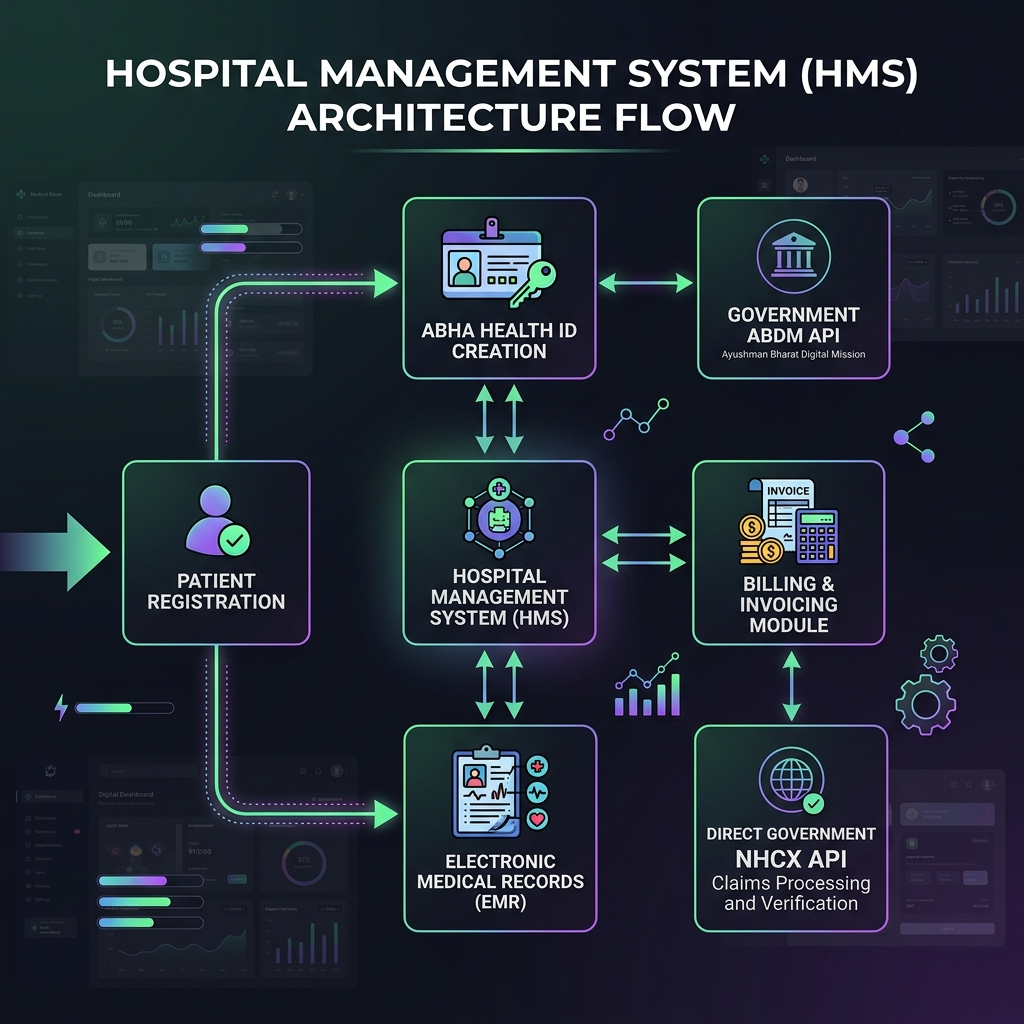
Figure 1: Complete data flow architecture of an ABDM-compliant HMS, detailing patient registration, EMR generation, billing workflows, and official NHA gateway integrations.
ABDM Milestones (M1, M2, M3) & NABH Audit Playbook
Ayushman Bharat Digital Mission (ABDM) Milestone Breakdown
ABDM compliance is divided into three key integration tiers that every Indian healthcare software provider must implement:
Milestone 1 (M1): ABHA Integration
Creation, verification, and capture of the 14-digit Ayushman Bharat Health Account (ABHA) number. Includes implementing the ABHA QR Code "Scan & Share" at OPD registration desks to eliminate manual forms.
Milestone 2 (M2): Health Document Linking
Generating and translating medical documents (prescriptions, diagnostic lab reports, discharge summaries) into standardized HL7 FHIR v4 schema. Clinicians link and share these records to the patient's personal health locker.
Milestone 3 (M3): Unified Health Interface
Integrating with the National Health Authority’s UHI protocols to allow patient-facing health apps (like ABHA, Aarogya Setu) to book OPD slots, consult remotely, and pay fees directly into the HMS.
The NABH Hospital Compliance Checklist
Passing a National Accreditation Board for Hospitals (NABH) audit requires specific, verifiable modules and safety controls inside your clinical software. Here is the checklist:
| Compliance Field | Required Control Component | Audit Verification Method |
|---|---|---|
| Clinical Audit Trails | Automatic time-stamping, IP-address logging, and doctor signature tokens for any changes to digital prescriptions or EMR records. | Inspect database system log files for unauthorized history modifications. |
| Infection Control Charting | Centralized tracking of hospital-acquired infections (HAI), surgical site infection rates, and vaccine administration logs. | Show automated dashboards indicating compliance trends to the auditor. |
| SOP & Clinical Protocol Guardrails | Prescription alerts for drug-drug interactions, high-risk drug warnings, and mandatory allergy verification fields. | Verify in-app drug interactions alerts and allergy-input blocks during patient checkout. |
| Asset & Calibration Logs | Automated scheduling and certification logs for medical devices (ventilators, OT monitors, PACS consoles). | Present preventative maintenance tickets and equipment uptime logs. |
Government Rules: ABDM, NHCX Claims, and the DPDP Act 2023
The Indian government is actively pushing hospitals and clinics to adopt digital health standards. Under the Ayushman Bharat Digital Mission (ABDM), patient records must be shared securely through the government's official gateway.
At the same time, the new DPDP Act of 2023 makes hospitals legally responsible for protecting patient data (like phone numbers, reports, and bills). This means your software must encrypt patient files, ask for explicit consent, and keep a clean log of who accessed what records.
For insurance, the National Health Claims Exchange (NHCX) is now the standard gateway. Instead of manually uploading PDFs to different portals, modern software connects directly to the NHCX API to settle cashless claims and pre-auths in hours instead of weeks.
Data Privacy Warning
Hospitals that do not encrypt patient records or keep clear logs of doctor access can face heavy fines under the DPDP Act. Making sure your database is secure is no longer optional—it is a legal requirement.
🧬 Standards Compliance: SNOMED-CT, ICD-10, and NHA Gateway
To share medical data securely under government frameworks, your system needs to follow standard medical formats:
SNOMED CT Coding
Cliniqwise maps clinical terms and diagnoses to the Systematized Nomenclature of Medicine (SNOMED CT). This ensures prescriptions follow a standardized format.
ICD-10 Diagnosis Codes
Diagnostic notes are matched with official ICD-10 codes automatically. This makes insurance claim submissions smoother and cuts down on coding mistakes.
HL7 FHIR v4 Standards
Exchanging health data with government portals uses the HL7 FHIR v4 format. This guarantees reports can be read securely by official government health apps.
How Smart Technology is Helping Doctors in Indian Hospitals (2026)
Modern hospital systems now use smart tools to reduce the time doctors spend typing and help speed up patient discharge:
Voice Prescription Assistant (Speech-to-Text)
Doctors can speak their notes directly into the system, and it automatically types out a structured digital prescription with correct drug names and dosages, saving time between patients.
Automatic Diagnosis Billing Codes (ICD-10)
The software automatically matches the doctor's diagnosis notes with standard medical billing codes. This ensures insurance claims are prepared correctly and processed without rejections.
Discharge & Bed Planning Tools
The system shows live bed availability and alerts the staff when a patient is ready for discharge, making bed allocation and ward handovers smooth.
Regional Language Support & Local Internet Realities
Indian hospitals and clinics outside metro cities face unique challenges, like spotty internet connections and staff who prefer regional languages:
Multilingual Billing & Consent Forms
Having software that can print bills and patient consent forms in regional languages (like Hindi, Telugu, Tamil, Marathi, and Bengali) makes it easier for patients and speeds up front-desk registration.
Offline Queue Management
To keep your hospital running when the internet goes down, advanced setups run a local backup system. Receptionists can still register walk-ins and take payments, and the data syncs back to the cloud as soon as connection is restored.
Technical Architecture & Server Setup
If you have an in-house IT team or database administrator, they will want to check the underlying technology stack before choosing a system:
Hosting Data in India (DPDP Compliance)
To meet government privacy rules, patient data must be hosted in India. Cloud-native systems like Cliniqwise keep all database records and patient files encrypted inside AWS servers in Mumbai, using isolated network segments for safety.
Direct Laboratory Machine Integration
The system connects directly to laboratory machinery and radiology tools (like PACS/DICOM) using standard HL7 and FHIR protocols. This lets test results flow directly into the patient's file without anyone having to type them manually.
Daily Backups & Zero Vendor Lock-in
All database systems should have automatic hourly backups with a 99.9% uptime guarantee. It is also important that your database backups are exportable in open formats (like SQL or JSON) so you are never locked into a single software provider.
SaaS vs. On-Premises: Cost & Maintenance Analysis
Deciding between SaaS (Software-as-a-Service) and local on-premises servers requires looking beyond initial licensing costs:
Cloud SaaS Architecture
- Zero up-front local server hosting hardware costs
- Automatic rolling updates for ABDM milestone changes
- Predictable monthly billing scaling with active beds
On-Premises Systems
- Full operations in zero-internet local LAN setups
- Requires dedicated in-house database engineering teams
- High up-front backup servers & local hardware costs
For 90% of clinics and mid-sized hospitals, a cloud-native certified platform like Cliniqwise HMS resolves the management overhead entirely. Only tertiary medical chains require custom hybrid setups engineered by partners like Tridev Technologies.
How much does Hospital Management Software cost in India? (Pricing Tiers)
Pricing for Indian HIS/HMIS systems depends on deployment model, bed count, and features selected. Here is a breakdown of pricing bands and estimated setup costs for 2026:
| Pricing Tier | Average Cost Band (INR) | Implementation Timeline | Data Migration Cost | Target Match |
|---|---|---|---|---|
| Clinic / OPD SaaS | ₹1,500 – ₹5,000 / month | 3 – 5 Days | Included (Excel/SQL import) | Single-Doctor & Multi-Specialty Clinics |
| Mid-Sized Hospital Cloud | ₹12,000 – ₹35,000 / month | 1 – 2 Weeks | ₹15,000 (Flat mapping fee) | 20 - 150 Bed secondary care centers |
| Enterprise / Hybrid HIS | ₹75,000 – ₹2,500,000+ / year | 4 – 8 Weeks | Custom ETL tariff based on volume | 200+ Bed tertiary/teaching chains |
Note on Hidden Costs: When comparing vendors, verify if their pricing includes SMS/WhatsApp delivery quotas, doctor payout share calculators, ASTM analyzer LIMS integrations, or ABDM certification maintenance. Many legacy software vendors charge hidden installation fees per client workstation, whereas modern SaaS like Cliniqwise starts at ₹2,000/month and scales based on the specific modules enabled.
Quantified Operational ROI by Facility Type
Post-implementation operational metrics gathered from 150+ clinics and hospitals digitised in India:
| Performance Metric | OPD Clinic (10-15 Doctors) | Mid-Sized Hospital (50-100 Beds) | Corporate Chain (250+ Beds) |
|---|---|---|---|
| Patient Waiting Time | Reduced by 45% (under 5 mins) | Reduced by 35% (under 12 mins) | Reduced by 30% (under 15 mins) |
| Billing Leakage Control | ~₹12,000 / month saved | ~₹1,85,000 / month saved | ~₹5,40,000+ / month saved |
| Pharmacy Expiry Recovery | FEFO prevention | 22% stock recovery | 30% waste reduction |
| Insurance Claim Approval Time (TPA) | Not Applicable | 18 days to 5 days | 14 days to 4 days |
The Legacy Migration Protocol: Safely Moving On-Premise HIS Data to Cloud-Native EMR Layers
Losing patient records during a system upgrade is a critical clinical hazard.Tridev Technologies uses a proprietary ETL (Extract, Transform, Load) mapping engine to ensure data integrity during cutovers:
1. Data Mapping & Schema Reconciliation
Extract raw legacy tables (SQL/Access), clean formatting issues, and map demographics into HL7-FHIR standards.
2. Secure Sandbox Test Seeding
Upload database snapshots to a sandboxed cloud environment to verify drug histories, ward transfers, and account dues.
3. 48-Hour Parallel Run
Operate both the legacy system and the new platform concurrently to verify registration, bills, and user comfort.
4. Off-Peak Midnight Cutover
Schedule the final database sync at Sunday 2:00 AM to ensure zero disruption to emergency ward desks.
Critical Workflow Integrations
Hospital Billing & GST Invoicing Rules
Hospital invoicing requires complex calculations: medicines attract different GST slabs (5%, 12%, 18%), room rent threshold taxes under municipal policies, and diagnostic tariffs varying by corporate agreement or TPA insurance rates. An HMS must auto-map service tariff schedules, manage multiple doctor commission configurations, and format GST invoices seamlessly.
Hospital Pharmacy & Integrated Inventory Control
Drug storage leaks represent a major revenue hole. Integrated pharmacy workflows route drug issue requests from EMR consults instantly. The system enforces FIFO/FEFO rules, tracks batch numbers, sends auto-expiry email notifications, and maintains re-order buffers.
Laboratory Information System (LIS) Interfacing
Connecting pathology lab machines directly to the patient dashboard eliminates typing errors. A modern HMS uses HL7/FHIR protocols to exchange test requests with hematology or clinical chemistry analyzers, captures results automatically, formats digital lab reports signed by pathologists, and releases reports to the EHR instantly.
Tridev Technologies: Health Informatics & Engineering Authority
Rather than a generic review aggregator, this guide is published directly by the health informatics and database migration engineers who design and maintain healthcare networks across India. Tridev Technologies is a premier B2B software engineering firm, and we are proud to be the engineering force behind Cliniqwise HMS.
150+
Hospitals Digitized
4M+
Records Migrated
99.9%
Uptime SLA Vetted
100%
DPDP 2023 Compliant
⚙ Our Engineering Role in Cliniqwise
As the technology partner for Cliniqwise, Tridev Technologies built its core database and security setup. We host the system on highly secure servers in Mumbai and ensure all patient reports are fully encrypted. We recommend Cliniqwise based on our firsthand knowledge of its security, speed, and reliability.
Vouched By Health Leaders
"Tridev Technologies migrated our 15 years of offline patient records to Cliniqwise in a single weekend. Our waiting room queues dropped by 35% using the ABHA QR Scan & Share system. Highly recommended!"
— Dr. Amit Khandelwal, Chief Medical Director, Apple Hospital
"Our hospital NABH audit was completed easily because the system keeps a clear log of patient consent and records. The GST billing and invoice splitting also works perfectly."
— Dr. S. K. Singh, Director, Bundelkhand Hospital
India Office Address:
Tridev Technologies, Nariman Point Mahalaxmi Nagar, Vridavan Palace Colony, Indore, Madhya Pradesh - 452010
Systems Integration Inquiries:
Contact: info@tridevtechnologies.com
SLA Support: support@tridevtechnologies.com
Frequently Asked Questions (FAQs)
Q: Which hospital software in India supports ABDM M3 integration?
A: Cliniqwise HMS supports full ABDM Milestone 1 (ABHA creation), Milestone 2 (digital health records linking), and Milestone 3 (Unified Health Interface - for booking doctor appointments online) integrations. This enables patient registration via QR code and secure data sharing across the national digital health ecosystem.
Q: What is the cost of hospital management software in India?
A: HMS pricing in India varies by model. Basic cloud-based clinic/OPD software ranges from ₹1,500 to ₹5,000 / month. Mid-sized hospital SaaS starts from ₹12,000 to ₹35,000 / month, while enterprise hybrid systems for 200+ bed facilities can cost ₹75,000 to ₹2,500,000+ / year. Cliniqwise starts at ₹2,000 / month depending on the modules enabled.
Q: What makes a hospital management system DPDP-aligned?
A: A DPDP-aligned HMS requires strict role-based access control, secure local data residency within India, end-to-end data encryption, and tamper-proof user audit trails. Systems must seek explicit digital patient consent before sharing or processing medical records.
Q: Is Cliniqwise suitable for small hospitals and nursing homes?
A: Yes, Cliniqwise is designed specifically for single-specialty clinics, nursing homes, and mid-sized hospitals (10–200 beds). It provides pre-configured templates for outpatient visits (OPD), inpatient admission (IPD), pathology labs (LIMS), pharmacy inventory, and ABDM compliance to speed up deployment.
Q: Does the system support ABHA ID creation during registration?
A: Yes. Cliniqwise supports instant ABHA ID creation and verification at the reception desk via Aadhaar OTP, mobile OTP, or scanning the patient's existing ABHA QR code. This links patient demographics directly to their digital health locker.
Q: Which hospital software integrates with PMJAY / Ayushman Bharat?
A: Cliniqwise and MocDoc integrate directly with the PMJAY portal. The system automates eligibility checks, maps treatments to national package lists, manages pre-authorizations, and enables paperless claim uploads for Ayushman Bharat patients.
Q: What are the NABH compliance checklist requirements for HMS?
A: For NABH accreditation, an HMS must support digital medical records with standard diagnosis codes (ICD-10), history logs for prescription edits, nurse medicine charts (MAR), infection control logs, and automated incident reporting.
Q: Does the software support GST e-invoicing and HSN codes?
A: Yes. Cliniqwise generates GST-compliant e-invoices with separate CGST/SGST breakdowns and HSN codes mapped to pharmacy consumables. This facilitates automated tax filing and prevents financial audit discrepancies.
Q: Which HMS supports TPA / insurance claim processing?
A: Cliniqwise and Practo's Insta HMS support digital TPA claims processing. Cliniqwise integrates directly with the NHCX (National Health Claims Exchange) gateway, enabling instant pre-authorizations and cashless claim settlements with major insurers.
Q: What is the ideal hospital size for Cliniqwise?
A: Cliniqwise is optimized for 10 to 200 bed healthcare facilities. For massive academic teaching hospitals (500+ beds) that require large-scale on-site servers and custom setups, legacy enterprise solutions like Backbone or hybrid configurations are recommended.
Q: Is cloud-based HMS secure?
A: Yes. Cloud-based systems like Cliniqwise are hosted in secure servers in India. They encrypt all patient records and files, providing higher security and disaster recovery than local physical computer setups.
Q: Can HMS work across multiple hospital branches?
A: Yes, cloud-based systems allow real-time multi-location synchronization. Managers can view patient records, doctor timetables, stock lists, and revenue analytics across multiple branches from a single unified administrative dashboard.
Q: What is NHCX and how does it affect hospitals?
A: The National Health Claims Exchange (NHCX) is a government-backed digital platform standardizing health insurance claim exchanges. An NHCX-ready HMS connects directly to the NHCX system, allowing paperless claim routing to TPAs and clearing approvals within hours.
Ready to Plan Your Digital Transformation Journey?
Tridev Technologies' systems architects and data migration engineers will help you choose, integrate, and deploy your next-generation hospital management system safely.